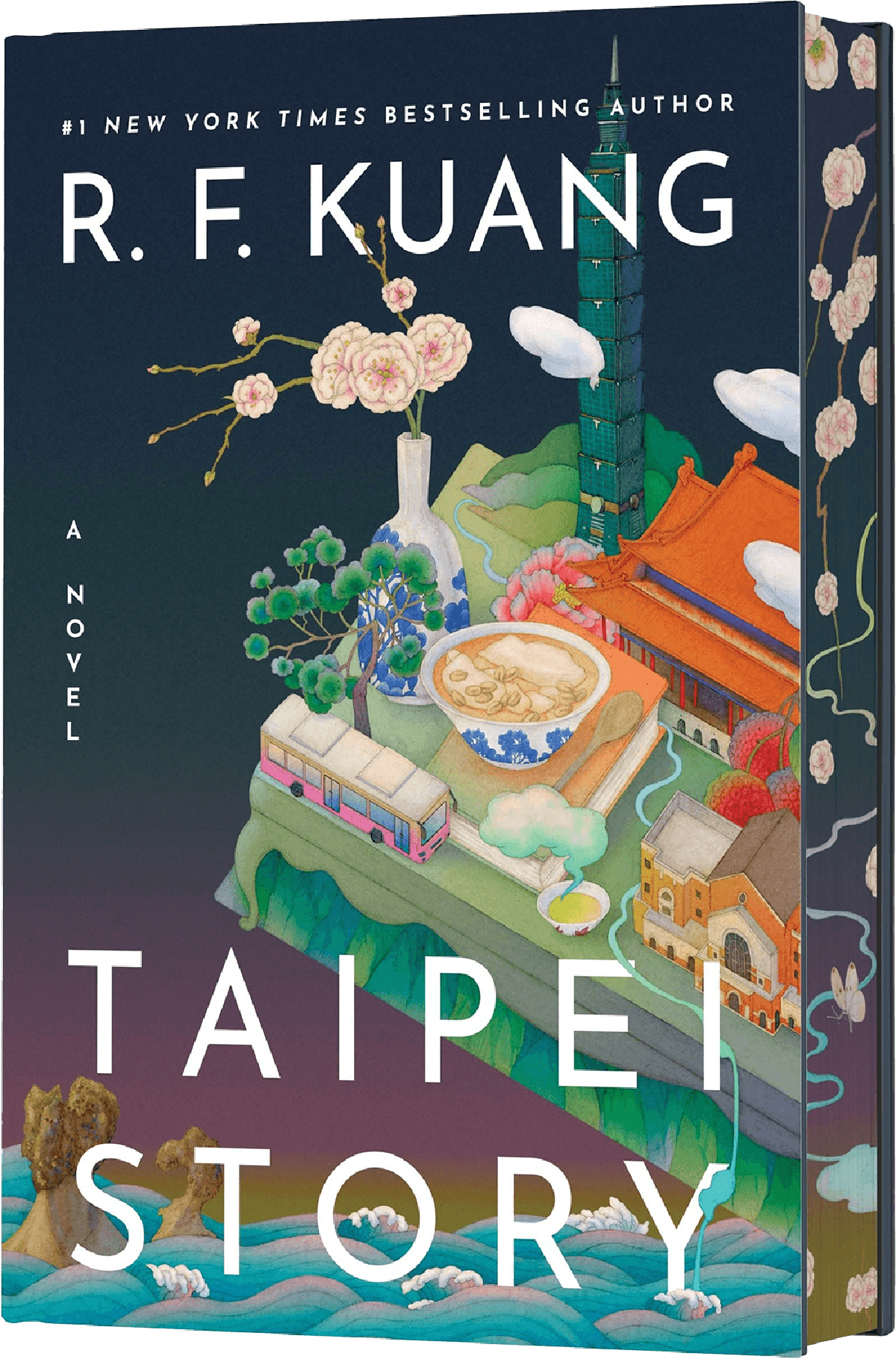
R.F. Kuang — the Chinese-American novelist behind Yellowface, Babel and the Poppy War trilogy — is facing a boycott campaign from her own readership after a leaked excerpt of her forthcoming novel Taipei Story revealed that the book contains a fleeting reference to an Israeli musician. The novel is due from HarperCollins on 8 September 2026.
The passage in question#
The disputed scene runs a few paragraphs. Lily, the protagonist, walks into Taipei’s National Concert Hall on a whim with her NTU student card, picks up the programme and reads:
The pianist was from Israel, and he was a big deal: He had performed at concert halls throughout Europe and the Americas and been a soloist with all sorts of philharmonic orchestras. This was his first time in Taiwan. The National Concert Hall was honored to host him.
Later in the scene, after the recital — a Liszt programme — the pianist is described as “a dour-faced man who did not so much as crack a smile as we applauded.” That is the full extent of the Israeli content of the novel as far as the leaked screenshots circulating on Threads, X and TikTok show. The pianist is unnamed, does not return, and is described as both eminent and a bit of a sourpuss.
Taipei Story itself, per HarperCollins, follows Lily Chen, a Chinese-American college freshman who travels to Taipei for an intensive Mandarin summer programme, only to be derailed by the death of her grandfather and the silences in her own family history. The book is marketed as a coming-of-age novel about diaspora, language and grief.
R.F. Kuang’s politics — and why this is an awkward controversy#
Kuang has aligned herself with the BDS movement’s framework on cultural boycotts. In late 2025 she withdrew from the Emirates Airline Festival of Literature in Dubai — a decision widely framed at the time as a “BDS withdrawal,” though the immediate trigger was the UN’s findings that the UAE has been arming the Rapid Support Forces in Sudan, not the UAE’s relationship with Israel. The Palestinian BDS National Committee had called on writers to boycott the Dubai festival in solidarity with Sudanese civilians, and Kuang’s statement invoked the wider principle: she has “always respected organized calls for cultural boycotts against genocide from communities directly affected and in particular, guidelines set forth by the BDS movement.” PACBI publicly thanked her.
So her public position is: pro-BDS as a framework, and willing to take a financial hit (a high-profile festival appearance, fees, audience) to act on it. That position has been read — by both her supporters and her current critics — as also implying full participation in the cultural boycott of Israel, even though her Dubai withdrawal was specifically about Sudan.
Against that backdrop, the Taipei Story excerpt is harder to fit into either camp’s narrative. Kuang did not write a sympathetic portrait of an Israeli soldier; she did not write an essay defending Israel. She wrote a passage in which an Israeli pianist exists, is described as internationally accomplished, performs Liszt, and is observed by the protagonist as cold-mannered. That treatment is not a polemic in either direction. For an author who has otherwise aligned herself with the cultural-boycott framework, the deliberate choice to invent an Israeli musician — rather than, as the Ordinary Times blog pointed out, a fictional musician of any other nationality — is a small but real authorial decision. Kuang has not explained it. Comments have been disabled on her recent Instagram posts and she has not commented publicly. Readers are left to interpret the passage on its own terms.
Where the backlash is coming from#
The pile-on is concentrated in the same Anglophone, online-progressive book-community spaces — BookTok, Bookstagram, Threads — that previously celebrated Kuang. One widely shared post, quoted in The Express Tribune, captured the tone: “RF Kuang had 190+ countries to choose from to write about a character’s nationality, and she still chose to write about the one who’s actively committing genocide against Palestinians for years.” Other readers reported cancelling their pre-orders.
The defence has come from the same constituency. A Threads user wrote that the people boycotting Kuang “over a single mention of an Israeli pianist being booked at a concert hall… lack so much f—ing nuance. There’s literally no mention of Zionism, yet y’all can’t seem to differentiate.”
The Ordinary Times blog noted a separate dynamic worth flagging: a number of the loudest critics on BookTok are themselves working YA authors, competing for the same finite reader attention and book-budget that Kuang dominates. In a publishing ecosystem where readers might buy a dozen books a year and BookTok decides much of what they pick, a high-profile competitor briefly stumbling into a “cancellable” passage is, in the cynical reading, a market opportunity.
Coverage in The Jewish Chronicle, JNS, The Times of Israel, Yahoo and several Pakistani and South Asian outlets has framed the episode as another example of literary boycott culture treating any acknowledgement of Israeli existence as an endorsement of Israeli policy.
How this lands in Taiwan#
Because Taipei Story is set in Taiwan and Kuang is one of the highest-profile Sinophone-diaspora writers working today, the book will be read carefully on the island as well. The political backdrop there is not the one her American critics are operating in.
Since 7 October 2023, Taiwan’s government has held a position broadly supportive of Israel. Taipei condemned Iran’s October 2024 missile attack on Israel in unusually direct language, signed a bilateral cultural exchange agreement with Israel that same month, and has continued to deepen security and humanitarian cooperation through Israeli representative Maya Yaron and Taiwan’s representative in Tel Aviv, Abby Lee. The intuitive sympathy comes from a shared self-image, articulated by the Taipei-based researcher Felix Brender-Wong: “Taiwan knows what it’s like to have a neighbour which doesn’t accept you exist.” The two states have a long, sometimes uncomfortable history together — Cold War “pariah” cooperation on arms and even nuclear technology — that older Taiwanese commentators are well aware of.
A pro-Palestinian current does exist in Taiwan, but it is small and concentrated in younger left-wing civil society rather than in mainstream politics. The Taiwan Alliance for a Free Palestine (TWAFP) coordinates rallies — about 200 demonstrators marched through Taipei’s Ximending district in October 2024 — and outlets such as New Bloom Magazine cover the cause regularly. Voices in this current, including the activist Aurora Chang and the Palestinian academic Hazem Almassry at National Yang Ming Chiao Tung University, argue that Taiwanese should identify with Palestinians on the basis of self-determination rather than with Israel on the basis of “small democracy facing a hostile neighbour.”
Kuang herself, on her stated public positions, sits squarely with this small Taiwanese pro-Palestinian left rather than with the Taiwanese mainstream. Her invocation of BDS guidelines, her anti-colonial frame of reference, and her academic milieu (Yale East Asian Languages and Literatures) are exactly the register in which TWAFP, New Bloom and the Ximending demonstrators operate. If she had set foot in Taipei the week of the October 2024 march, that is the demonstration she would plausibly have attended.
What makes the Taipei Story passage interesting is precisely that it does not read as a piece of writing produced from inside that political position. Lily picks up the programme, registers that the pianist is from Israel, registers that he is internationally distinguished, sits through the recital, and finds him personally cold. There is no commentary on his nationality, no mention of Gaza, no narrative weight placed on the fact that an Israeli is performing in Taipei at all. In purely textual terms, that is much closer to how the Taiwanese mainstream — which finds nothing remarkable about an Israeli soloist headlining the National Concert Hall — would read the scene than to how Kuang’s TWAFP-aligned political peers would frame the same encounter.
So the Taiwanese readership splits two ways. The English-reading, US-discourse-following activist left will likely join the BookTok boycott. The much larger mainstream reading public — for whom Israeli classical musicians touring Taipei is genuinely unremarkable, and for whom the protagonist’s “dour-faced” line will register as routine concert-goer commentary — will probably not understand what the fuss is about. Kuang’s politics align with the first group; her actual sentence aligns with the second.
What the controversy actually reveals#
The story is not really about R.F. Kuang. She has written a novel about a Chinese-American girl in Taipei trying to understand her grandfather, and she has populated it — as authors do — with peripheral people who exist. One of them happens to be Israeli. That this is enough to trigger pre-order cancellations and a multi-outlet news cycle says more about the boundaries the boycott constituency is now policing than it does about Kuang’s politics, which remain what they were. For Asian-American literature in particular, it raises an awkward question that the field has so far avoided: whether an Asian-American writer is now permitted to put an Israeli, of any kind, on the page at all.
View this post on Instagram
Sources: The Express Tribune, The Jewish Chronicle, HarperCollins, Global Taiwan Institute, Literary Hub, Ordinary Times.