Yesterday a Hebrew-language Instagram carousel by the Israeli self-help account @danielmorad_1 told its readers that “the third principle of Ikigai” is Jōnetsu — passion. The post lays out a numbered hierarchy: Spark (התלהבות רגעית, momentary excitement), Burning (מסירות, devotion), and Core (התמזגות, fusion — Flow). The framing is unmistakable: this is presented as Japanese tradition, with Japanese kanji and a numbered system attributed to the wisdom of Japan.
It is a falsifiable claim. Either there is a numbered Japanese system called “the principles of Ikigai” with Jōnetsu as principle three, or there isn’t. So we checked.
What Ikigai is in Japanese sources#
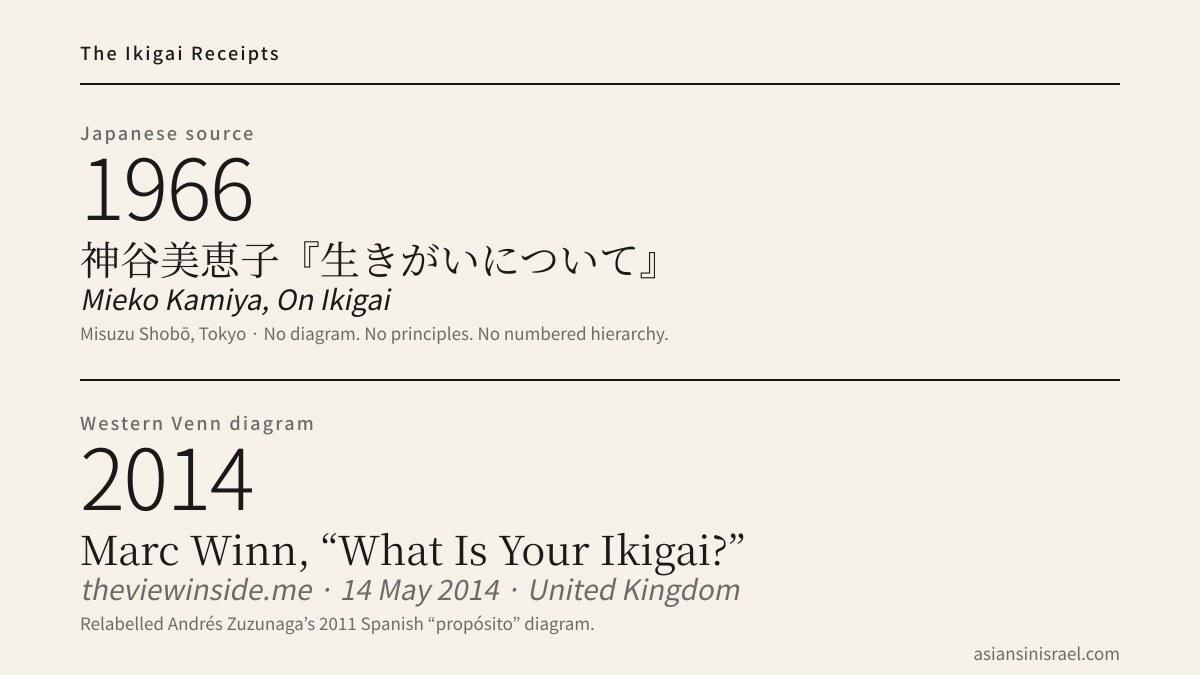
The foundational academic treatment of ikigai (生きがい) in Japanese is Ikigai-ni-tsuite (生きがいについて) by the psychiatrist Mieko Kamiya (神谷美恵子, 1914–1979), published by Misuzu Shobō in Tokyo in 1966. Kamiya developed her thinking through years of clinical work with leprosy patients at the Nagashima Aiseien Sanatorium; her book is still treated as a standard reference by Japanese researchers six decades later.
Kamiya’s ikigai is a phenomenological category: the felt sense that one’s life is worth living. It is approached through case histories, philosophical reflection, and clinical observation. There is no four-circle Venn diagram in her book. There are no “principles” of ikigai. There is no numbered hierarchy in which Jōnetsu sits at position three.
In everyday Japanese, the word is broader and looser than the English self-help genre allows. Children speak of their ikigai as collecting stamps. Retirees speak of their ikigai as their grandchildren. The neuroscientist Ken Mogi, whose 2017 book The Little Book of Ikigai (Quercus, 7 September 2017) is the most-translated Japanese-authored explanation aimed at Western readers, has been direct in interviews about the Western diagram: it is “completely wrong,” and ikigai in Japan is “much more flexible and tolerant” than the schematic it has become abroad.
Notice what is not in any of this: a numbered list of principles. Not in Kamiya. Not in Mogi. Not in everyday usage.
Where the four-circle diagram came from#
The famous Venn diagram that flooded LinkedIn, TED-style decks, and Hebrew self-help feeds — four circles labelled “what you love / what you’re good at / what the world needs / what you can be paid for,” with ikigai in the middle — is not Japanese. It was published in English on a British personal blog on 14 May 2014.
The author, Marc Winn, has stated explicitly what he did. He encountered Andrés Zuzunaga’s 2011 Spanish-language Venn diagram of propósito — purpose — which already had the four overlapping circles. He had also watched Dan Buettner’s TED Talk How to Live to Be 100+, which used the Japanese word ikigai in describing Okinawan longevity. So Winn took Zuzunaga’s diagram and changed one word. In his own description: “His 2011 framework mapped four intersecting elements: what you love, what you’re good at, what the world needs, and what you can be paid for. The diagram resonated with me, but its label — ‘Purpose’ — felt limiting. In a moment of insight, I replaced ‘Purpose’ with ‘Ikigai.’”
That sentence is the receipt. The diagram is Spanish. The word swap is British. The implied claim “this is from Japan” is false.
Zuzunaga himself confirmed the lineage on Winn’s own blog. In an April 2017 comment on the original 2014 post, he wrote that the graphic “is copy of a spanish graphic made [by] Andrés Zuzunaga two years before (2012),” and pointed to its earlier Spanish-language publication.
The diagram now circulates as ancient Japanese wisdom. It is younger than Instagram.
What Jōnetsu is and isn’t#
The Instagram carousel does the same move at smaller scale. Jōnetsu (情熱) is a perfectly ordinary Japanese word: passion, ardour, enthusiasm. You can hear it on a baseball broadcast or read it in a job advertisement. It has no canonical role as “the third principle of Ikigai,” because there is no canonical sequence of Ikigai principles to be third in.
The carousel’s three-stage structure — momentary spark, sustained burning, fused core / Flow — is not from Japanese tradition either. It is a recognisable summary of Mihály Csíkszentmihályi’s Flow: The Psychology of Optimal Experience (Harper & Row, 1990), with Japanese vocabulary applied on top. Csíkszentmihályi was a Hungarian-American psychologist at the University of Chicago. The Japanese word “Flow” appears in Japanese self-help precisely because it was imported from his English-language work, not the other way around.
What is presented in the post as a Japanese tier system is, on inspection, a Western motivational schema with Japanese labels stuck to its three rungs.
A reader’s test#
This is the broader pattern, and the reason it matters here. Once you notice the move — invent a numbered framework, attach a Japanese word, present as ancient — you start to see it everywhere. Hebrew “Kaizen in five steps” courses sit at a great distance from the Toyota Production System literature on which the term kaizen (改善) was actually built. “The seven rules of Wabi-Sabi” lists circulate freely in English and Hebrew with no counterpart in Japanese aesthetic-philosophy sources. Pop-Mottainai bypasses the Buddhist environmental-ethics genealogy of the original.
The corrective is not to retreat from Japanese vocabulary, and certainly not to treat Japanese words as too sacred to use — that would be its own kind of orientalism, the inverted-flattering kind that pretends East-Asian terms carry a depth other languages lack. Words are for using.
The corrective is a small set of factual questions. Before trusting a piece of “Japanese wisdom” content, ask:
- Is there a Japanese-language source older than the framework being claimed? If “the three principles of Ikigai” is ancient, where in Kamiya, in Mogi, in any pre-2014 Japanese text does the trio appear?
- Does the source author cite that Japanese-language source — or only other English self-help books? A chain of citations that ends in 2010s Anglophone material and never reaches Japan is a tell.
- Can the claim be dated before 2014? The 2014 cut-off is a specific test for ikigai content because of Winn. For other concepts, find the analogous origin date.
For Japanese readers, the value is recognising when one’s culture is being used as decoration. For Israeli readers interested in Asia, the value is a sharper instrument for distinguishing what was actually thought in Japan from what was thought in Britain or California and stamped with a Japanese label on the way out.
The fault, named precisely#
The fault here is not “using Japanese words.” Words are for using, and ikigai is a real and rich word with real Japanese scholarship behind it.
The fault is asserting that an invented numbered system is Japanese tradition when it isn’t. Ikigai is a real Japanese word. The four-circle Venn diagram is a 14 May 2014 British blog post. “The third principle of Ikigai” is, on present evidence, neither.
Sources: Mieko Kamiya, Ikigai-ni-tsuite, Misuzu Shobō, 1966; Ken Mogi, The Little Book of Ikigai, Quercus, 2017; Marc Winn, “What Is Your Ikigai?” and “The Story Behind the Ikigai Venn Diagram”, theviewinside.me, 14 May 2014; Mihály Csíkszentmihályi, Flow: The Psychology of Optimal Experience, Harper & Row, 1990; the triggering Instagram post by @danielmorad_1.