Tomorrow, 14 April 2026, Israel stops. Sirens sound, cafes close, and for two minutes the country stands in silence for the six million murdered in the Shoah. It is the one day on the Jewish calendar reserved above all others for the moral obligation lo od pa’am — never again, and never to anyone.
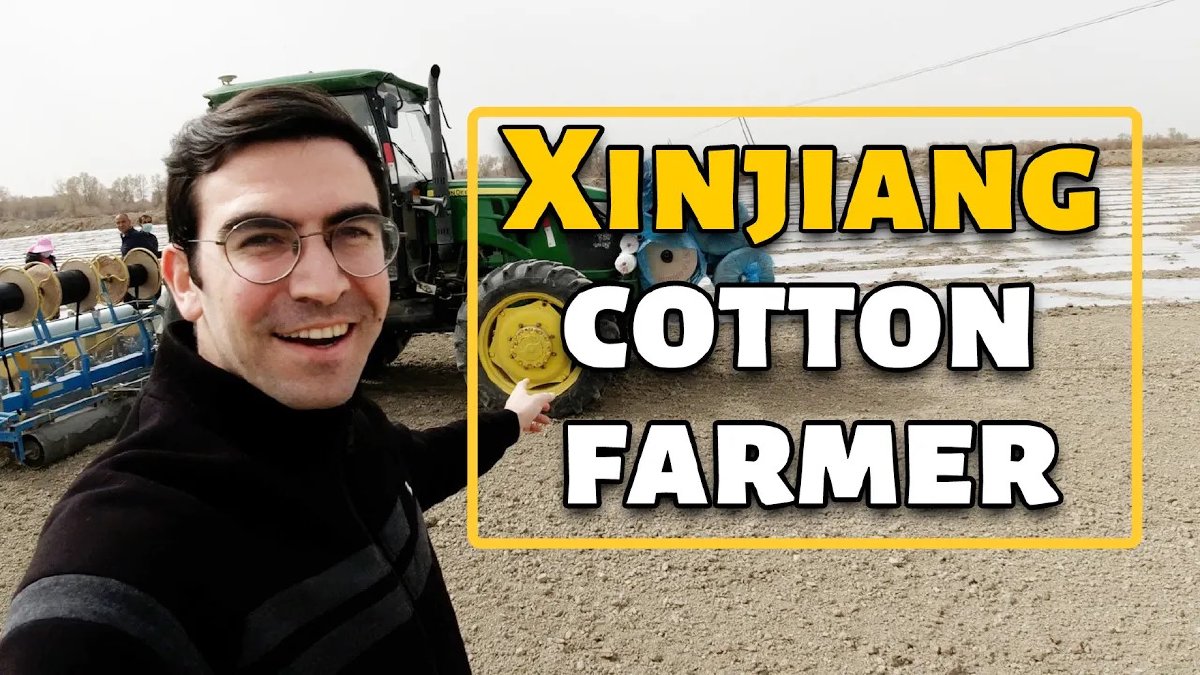
Five years ago, on 8 April 2021 — Yom HaShoah 5781 — an Israeli man in Beijing chose that exact day to publish a nearly fifteen-minute video from a Xinjiang cotton field, assuring his international audience that the mass internment of Uyghur Muslims is a Western fabrication and that everything in the region is, in his words, “totally normal.”
His name is Raz Gal-Or (רז גלאור; Chinese: 高佑思, Gāo Yòusī). He is arguably the most successful Israeli influencer in China. He is also, according to reporting by the BBC, the New York Times, Deutsche Welle, the Australian Strategic Policy Institute and Freedom House, one of the Chinese Communist Party’s most valuable foreign mouthpieces. On the anniversary of the Holocaust, he chose to lend a Jewish, Israeli face to genocide denial.
From Tel Aviv to Peking University#
Gal-Or was born in 1994 in a community near Tel Aviv. At thirteen he followed his father, the Israeli venture capitalist Amir Gal-Or, to Hong Kong, then on to mainland China. He attended the Canadian International School of Hong Kong, and studied international relations at Peking University — the Chinese Communist Party’s flagship institution for training future cadres. The South China Morning Post politely observed in 2017 that “his China journey was driven by the ambitions of his father.”
In December 2016, while still a student, Gal-Or co-founded YChina — 歪果仁研究协会, the “Foreigner Research Institute” — with his Chinese classmate Fang Yedun (方晔顿). The name is a sly pun: 歪果仁 (wāiguǒrén, “crooked nuts”) sounds almost identical to 外国人 (wàiguórén, “foreigner”). The schtick was light: goofy foreigners discovering Chinese dumplings, Chinese trains, Chinese tech.
The business model was less light. Amir Gal-Or’s Infinity Group — the pioneer Israeli venture fund in China — co-led a ¥10 million (about US$1.5 million) seed round alongside Will Hunting Capital (唯猎资本). That capital, and the connections that came with it, helped push YChina from a student channel to a company managing more than thirty foreign influencers with a combined 100 million followers across Weibo, Bilibili, Youku, Xiaohongshu and YouTube. Few 22-year-olds break the Chinese media market. This one had a father already inside it.
“Borrowing a mouth to speak”#
Chinese state media has a term for what Gal-Or does: 借嘴说话 — jiè zuǐ shuō huà, “borrowing a mouth to speak.” The strategy, well documented by the Alliance for Securing Democracy and by ASPI’s Borrowing mouths to speak on Xinjiang, is to amplify foreign voices that say what the Party cannot credibly say in its own accent. Gal-Or is not just a passive amplifier. The BBC reported in July 2021 that he works as a “global stringer” — a paid contributor — for CGTN, the Communist Party’s English-language state broadcaster.
The 8 April 2021 Xinjiang trilogy#
In April 2021, as H&M, Nike, Burberry and other Western brands announced they would no longer source cotton from Xinjiang over well-documented forced-labour concerns, Beijing needed counter-narratives fast. YChina delivered three.
- “What is the REAL Xinjiang like? I’m going there to find out!” — the two-minute teaser (
bv_zJf6a8nI, uploaded 2 April 2021), promising an unvarnished look. - “What I saw in Xinjiang working as a Cotton Farmer” — the fourteen-and-a-half-minute main event (
67pU0Ybovnc), uploaded on 8 April 2021, Yom HaShoah. Gal-Or, grinning under a wide-brimmed hat, picks cotton and declares the region “totally normal.” Two farmers, on camera, flatly deny any forced labour exists. - “I visited 3 families in Xinjiang, here is what they told me” (
5gbD-vfO_OU, uploaded 11 April 2021) — the follow-up, claiming spontaneous access to “random Xinjiang locals.”
The BBC noted that Gal-Or was accompanied on these trips by a CGTN film crew — the same state broadcaster that later re-cut his footage as “Foreign blogger Raz Galor visits cotton farm in Xinjiang” and pushed it through its own channel. New York Times Asia technology reporter Paul Mozur then documented, in a December 2021 thread, that a single Gal-Or Xinjiang video had been shared by 35 Chinese-government-linked accounts with a combined 400 million followers, many of them Chinese embassies on Facebook reposting it in multiple languages.
The United States government has designated the treatment of the Uyghurs a genocide. The UK, Canadian and Dutch parliaments have passed the same designation. The independent Uyghur Tribunal in London ruled in December 2021 that crimes against humanity and genocide had been committed. Amnesty International and Human Rights Watch have documented mass arbitrary detention, forced sterilisation, family separation and systematic cultural destruction.
On the day Israel remembered its own murdered, Raz Gal-Or’s contribution to this record was to tell the world it was not happening.
Still on the payroll#
This is not a youthful misstep from which he has distanced himself. YChina has continued to function as a reliable CCP-aligned channel. Gal-Or collected multiple prizes at the 2021 state-run “My China Story” international short-video awards. In November 2023 he was announced as a brand ambassador for FOTILE (方太), one of China’s largest kitchen-appliance companies, beaming that “happiness starts from the kitchen.” Freedom House’s 2022 Beijing’s Global Media Influence: Israel report named him the single most prominent Israeli vector of CCP-aligned narratives.
Meanwhile the Xinjiang Police Files, leaked to a consortium of international journalists in 2022, put faces on the camp detainees Gal-Or told us did not exist.
Why this matters, especially tomorrow#
Reasonable people can disagree about how much personal moral responsibility a foreign vlogger carries for what a foreign state does with his videos. Reasonable people cannot disagree about the facts: on Yom HaShoah 2021, an Israeli citizen with more than a quarter of a million YouTube subscribers, funded out of the starting gate by his father’s China venture fund, recorded a piece of content whose sole editorial purpose was to tell a global audience that a programme of mass ethno-religious persecution was a lie invented by the West. That content was then pumped out through Chinese embassies to hundreds of millions of people. It is still online.
Lo od pa’am is not a slogan about Jews only. Ask any Holocaust survivor who ever spoke in a school gymnasium what the promise was; they will tell you it was about anyone, anywhere, whose neighbours were disappeared into camps. It was not a promise to stand up for Uyghurs only when it is commercially convenient. It was certainly not a promise to publish cheerful denials on the anniversary itself.
Tomorrow the sirens will sound in Israel. Raz Gal-Or will, presumably, be in Beijing. The videos are still up. The audience is still watching. The question is whether the Israeli public, and Israeli media that has been remarkably quiet about one of its own, will remember what they were supposed to remember.
Sources:
- BBC News, “The foreigners in China’s disinformation drive” (10 July 2021)
- The New York Times, “China Uses YouTube Influencers to Spread Propaganda” (13 December 2021)
- Deutsche Welle, “Truth or lies: The expat YouTubers praising China” (11 November 2021)
- ASPI, “Borrowing mouths to speak on Xinjiang” (10 December 2021)
- ASPI, “Singing from the CCP’s songsheet” (November 2023)
- Freedom House, “Beijing’s Global Media Influence: Israel 2022”
- Paul Mozur, Twitter/X thread (14 December 2021)
- South China Morning Post, “How the Israeli who captured Chinese hearts plans to turn online fame into fortune” (25 November 2017)