In 2014, the Anti-Defamation League’s first-ever Global 100 survey delivered a startling finding: 53% of South Koreans harbored antisemitic attitudes — more than double the 26% global average and far exceeding regional neighbors like Japan (23%) and China (20%). South Korea’s score placed it closer to Iran (56%) than to the rest of East Asia. A decade later, the picture has shifted dramatically.
The 2014 Shock#
The original ADL Global 100 surveyed over 53,000 people across more than 100 countries, measuring agreement with 11 classic antisemitic stereotypes. South Korea’s 53% index score was one of the survey’s most unexpected results. Majorities agreed that Jews “have too much power in the business world,” are “more loyal to Israel than to this country,” and “have too much control over global affairs.”
Writing in The Diplomat at the time, Steven Denney and others noted the paradox: a country with virtually no Jewish population and no history of Jewish persecution had somehow developed deeply entrenched antisemitic stereotypes. South Korea’s score surpassed Indonesia (48%) and rivaled some Middle Eastern nations, despite having no comparable geopolitical grievances.
A Decade Later: The 2025 Update#
The ADL published its updated Global 100 data in January 2025, based on surveys conducted between July and November 2024. The results tell a story of diverging trajectories:
- South Korea: Down from 53% to 45% (an 8-point improvement)
- Global average: Up from 26% to 46% (nearly doubling)
- Asia overall: Up from 22% to 51%
- Indonesia: Up from 48% to a staggering 96%
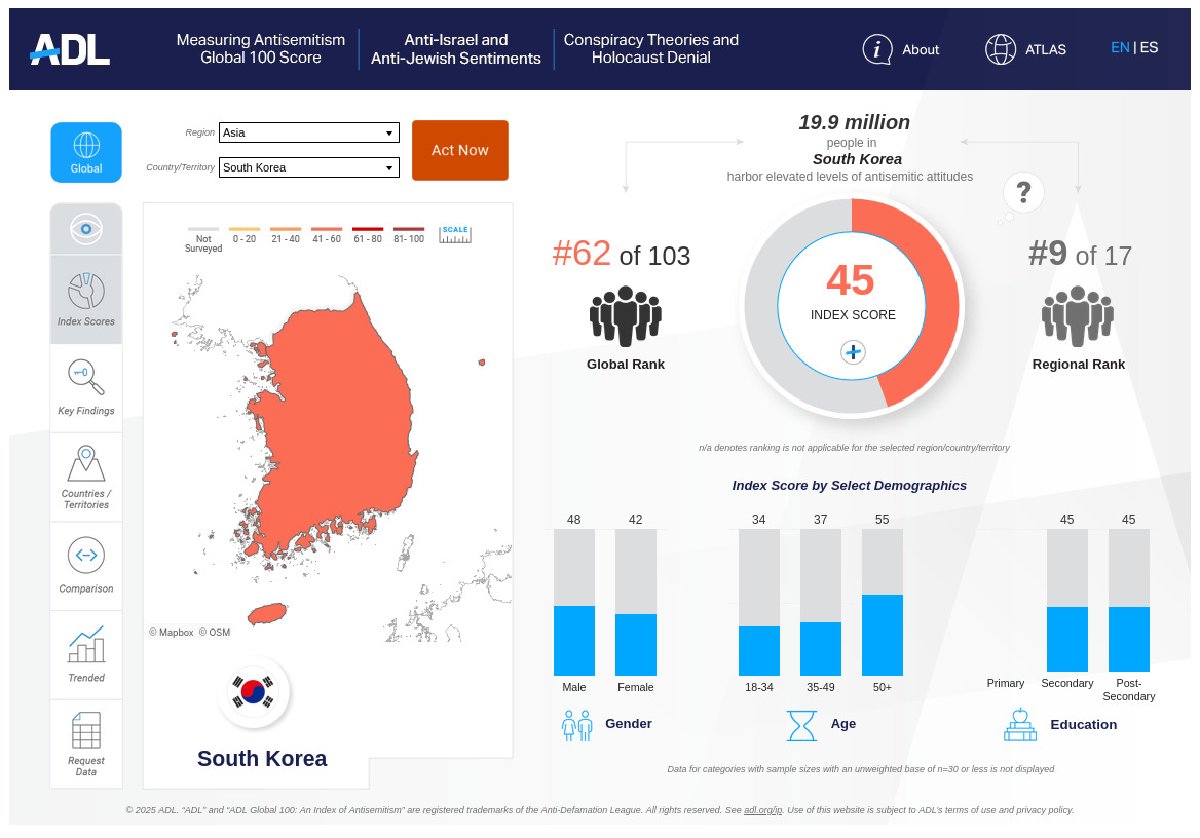
South Korea now ranks 62nd out of 103 countries surveyed and 9th out of 17 in Asia — placing it below the global average for the first time. The ADL estimates that approximately 19.9 million South Koreans still hold antisemitic views, but the trend line is moving in the right direction.
Who Holds These Views?#
The demographic breakdown reveals important patterns. By age, the gap is striking: only 34% of South Koreans aged 18–34 agreed with antisemitic stereotypes, compared to 55% of those over 50. The 35–49 age group fell in the middle at 37%. Gender differences were modest, with men at 48% and women at 42%.
Perhaps most surprising is the education data: antisemitic attitudes held steady at approximately 45% across all education levels — primary, secondary, and post-secondary. Unlike many countries where higher education correlates with lower prejudice, South Korea’s stereotypes about Jews appear to cut across educational backgrounds.
Cultural Roots: Admiration and Stereotypes#
South Korea’s relationship with Jewish culture is complex and paradoxical. Korean translations of the Talmud have been perennial bestsellers, and “Jewish education” and “Jewish success secrets” are popular genres in Korean bookstores. But this admiration often flips into envious stereotyping — the same qualities praised as wisdom can be recast as cunning or excessive influence.
Several cultural factors feed the pattern. The cartoons and writings of Rhie Won-bok, whose popular series depicted Jews as controlling global finance, introduced conspiracy theories to a mass audience. Korea’s highly competitive media landscape occasionally amplifies “Jewish money” narratives. The country’s strong evangelical Christian community brings a mix of biblical philo-Semitism and older theological stereotypes. And minjok (민족), the Korean ideology of ethnic nationalism, creates an in-group/out-group framework that can intensify suspicion of perceived outsiders.
Positive Steps#
Despite the complex picture, South Korea has taken notable steps to combat antisemitism and build ties with the Jewish world:
- In August 2021, South Korea became the first Asian nation to adopt the IHRA working definition of antisemitism, signaling official recognition of the problem.
- Following October 7, 2023, South Korean Christian Zionists opened the country’s first Holocaust museum, aiming to educate the public about Jewish history and suffering.
- A small but growing Jewish community of approximately 2,000 people (per the U.S. State Department’s 2023 report) is supported by a Chabad House established in Seoul in 2011, along with a mikveh and regular religious services.
- Israel and South Korea have maintained diplomatic relations since 1962, with growing cooperation in technology and defense sectors.
Looking Ahead#
The generational divide in South Korea’s data offers reason for cautious optimism. Younger Koreans, more globally connected and exposed to diverse perspectives, are significantly less likely to endorse antisemitic stereotypes than their parents and grandparents. If the trend continues, South Korea’s rate could fall further as the population shifts.
At the same time, global trends are moving in the opposite direction. The post-October 7 environment has seen antisemitic attitudes surge worldwide, with Asia’s regional average more than doubling. South Korea’s improvement against this backdrop is all the more noteworthy — and worth studying for lessons that might apply elsewhere.
Sources: The Diplomat, ADL Global 100, Combat Antisemitism Movement, Tablet Magazine