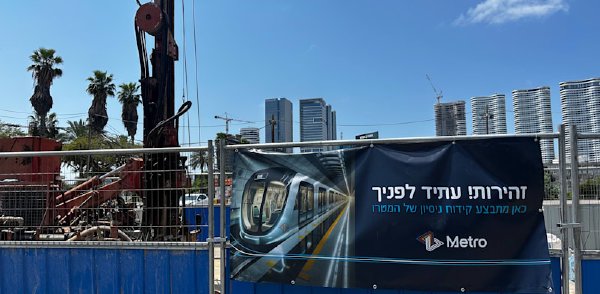
As Israel launches its largest infrastructure project—the NIS 65 billion Metro construction—a fundamental question looms unanswered: What happens if a Chinese company bids, or even wins? Despite intense US pressure and growing European boycotts, Israel has no declared policy on Chinese involvement in infrastructure projects.
The Metro Tender#
Published in November 2025, the Metro tender calls for creation of a contractor pool to compete for eleven infrastructure packages, each worth billions of shekels. Senior officials at NTA Metropolitan Mass Transit state that no company is barred based on country of registration—yet precedent suggests otherwise.
The gap between official openness and practical reality reflects Israel’s delicate balancing act between economic pragmatism and geopolitical pressures.
Precedents: When Chinese Bids Were Blocked#
Green and Purple Light Rail Lines#
In tenders for the Dan Region’s Green and Purple light rail lines, a Chinese consortium partnered with Israeli firms Shikun & Binui and Egged. The consortium submitted the lowest bid and was expected to win, but NTA’s tender committee disqualified the proposal as “manipulative.”
While the committee’s decision was legally upheld as professional, intense pressure from the Trump administration (during his first term) coincided with the disqualification. Even if taken on purely technical grounds, the decision alleviated political concerns.
Jerusalem Blue Line Rolling Stock#
After Polish company PESA withdrew from the Jerusalem Blue Line project during the war, Israeli consortium Dan and Danya Cebus turned to China Railway Rolling Stock Corporation (CRRC) as an alternative supplier. CRRC already supplies railcars for the Gush Dan Red Line.
When the company sought approval from Israel’s Finance Ministry, overt US intervention blocked the deal. Market sources claim parties with ties to the US administration leveraged those connections to scuttle the agreement in favor of other companies.
Ultimately, a compromise allowed CRRC to supply railcars from its Australian plant instead, resulting in a 20% price increase. Notably, while Israel refused to sign for Jerusalem’s Blue Line rolling stock, it simultaneously negotiated with the same company for additional Tel Aviv Red Line railcars.
Haifa Fuels Port#
Last year, China Harbour Engineering Company (CHEC) was disqualified on security grounds from the Haifa fuels port tender. The company petitioned, arguing that restrictions on Chinese firms should be made transparently by the government, “not on the basis of an ad hoc recommendation by the National Security Council.”
The state responded: “This is not a blanket disqualification; any future case will be examined on its merits.” The petition was ultimately dismissed by consent.
Where Chinese Companies Succeeded#
Despite high-profile rejections, Chinese involvement continues:
Haifa Bayport Terminal: Chinese company SIPG won the 2015 tender to operate the port as the sole bidder. Despite claims the port would shut down during emergencies, it operated normally during the war, even under missile fire. Israel’s Noy Fund later acquired a 25% stake for NIS 600 million—interpreted as SIPG’s effort to shed the “Chinese port” label by bringing in an Israeli partner.
Subcontractor Roles: Chinese companies serve as subcontractors in Green Line excavations, construct the tunnel under Tel Aviv, and participated in excavating the Gush Dan Red Line—whose rolling stock is also Chinese.
China’s Workaround Strategy#
“Chinese companies understand which way the wind is blowing, even if things aren’t said out loud,” observes Galia Lavi, deputy director of the Glazer Israel-China Policy Center at the Institute for National Security Studies (INSS).
Lavi’s research examined 46 tenders worth NIS 100 million or more between 2001 and June 2022:
- 2019: Peak year—Chinese companies won every tender they bid for (four total)
- 2020: Turning point—won only one of four tenders
- Post-2020: Sharp decline in bids submitted
“Chinese companies are taking a workaround approach,” Lavi explains. “They understand the chances of winning tenders for large, heavy infrastructure projects are low, so they’re positioning themselves as subcontractors instead.”
This strategy appears across projects: Green Line construction (working under developer companies), Jerusalem Blue Line railcars, and power station construction in northern Israel.
“Israel loses out twice,” Lavi notes. “First, because it has less oversight, and second, because it’s more expensive.”
The European Vacuum#
Israel’s infrastructure market once featured fierce competition among European companies. Chinese entry in recent decades widened the competitive field—European firms often couldn’t match Chinese prices.
Today, however, European companies face pressure from pro-Palestinian organizations, committees, politicians, and investors, making Israeli operations increasingly difficult.
The government is attempting to expand options by courting companies from South Korea and India, with NTA delegations visiting both countries to promote Metro participation.
Israel’s Policy Incoherence#
“Israel has no interest in saying Chinese companies are unwelcome here, and it does have an interest in involving them in tenders,” Lavi observes. Yet Israel refrains from transparent policy statements.
The result is case-by-case decision-making vulnerable to external pressure, lacking consistent criteria or public accountability.
“In my opinion, Chinese companies should not be restricted from digging a tunnel and building infrastructure,” Lavi argues. “Everything is done under Israeli supervision, and I don’t see any impediment unless it’s a matter of sensitive sites. Construction work does not grant control over the assets. I also don’t see foreign companies lining up to work here.”
Implications for Israel’s Asian Relationships#
The Metro controversy reveals tensions in Israel’s Asian relationships:
US-China Competition: Israel finds itself caught between American strategic pressure and Chinese economic advantages, forced to navigate without clear policy guidelines.
Economic Pragmatism vs. Geopolitical Alignment: Chinese companies offer competitive prices and proven capabilities, yet geopolitical considerations override economic efficiency.
Transparency Deficit: Ad hoc decisions by committees and informal US interventions replace transparent governmental policy, leaving companies and the public unclear about actual criteria.
Asian Alternatives: Attempts to attract South Korean and Indian companies suggest Israel seeks to maintain Asian economic partnerships while reducing reliance on China.
For Israel’s Chinese community and businesses, the uncertainty creates challenges—unclear whether commercial relationships in infrastructure will remain viable or face increasing restrictions.
The NIS 65 billion Metro represents Israel’s largest infrastructure project, yet the question “Who decides if China will build it?” remains unanswered—revealing deeper questions about how Israel balances economic interests with geopolitical pressures in an era of intensifying US-China competition.