Indonesian President Prabowo Subianto surprised diplomats at the United Nations General Assembly in September when he concluded his address with a single Hebrew word: “Shalom.” For the leader of the world’s largest Muslim-majority country, which has no formal relations with Israel, the gesture signaled a potential shift in Jakarta’s approach.
Subianto’s Surprising UN Speech#
Before ending with “peace” in Hebrew, Subianto spoke sympathetically about Israel, stating that the world must “recognize,” “respect” and “guarantee the safety and security of Israel.” He offered to send 20,000 peacekeepers to Gaza and said Indonesia would “immediately” recognize Israel once it recognizes a Palestinian state.
Three weeks later, during US President Donald Trump’s visit to Israel to mark implementation of his Gaza peace plan, Israeli media reported that Subianto would make a landmark visit to Jerusalem. The Indonesian president has earned repeated public praise from Trump for his enthusiasm in advancing the Gaza plan.
However, Indonesia’s Foreign Ministry quickly issued clear denials of any such trip, affirming their longstanding support for Palestinians in Gaza. Sources indicated that Subianto had approved the visit but backed out once plans leaked to the press, fearing domestic backlash.
Constitutional Constraints#
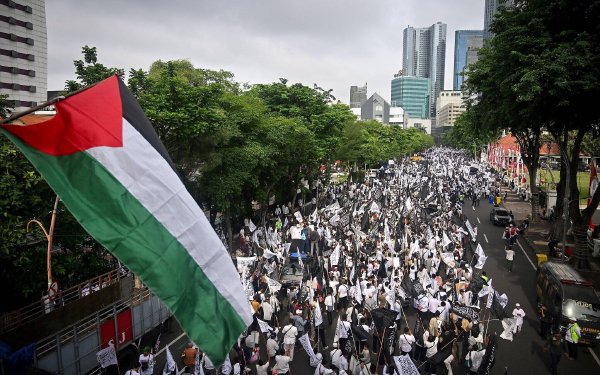
The resistance to normalization runs deep in Indonesian society. When Indonesia declared independence from the Dutch Empire in 1945, it enshrined opposition to colonialism as a core constitutional principle. Many Indonesians view Israel as occupying Palestinian land and denying Palestinians statehood.
“Whenever someone deviates from the official stance on ties with Israel, that deviation is seen as a deviation from the constitution itself,” explained Giora Eliraz, a research fellow at Hebrew University’s Harry S. Truman Institute. For Indonesia’s Muslim majority, the motivation extends beyond politics. “The Palestinian people are seen as part of the collective Muslim identity. Anyone who diverges from that line is seen as deviating not just politically, but on a faith-based level.”
Historical Precedent#
Indonesia’s ideological rigidity has not entirely precluded engagement with Israel. During President Suharto’s authoritarian rule from the late 1960s to the 1990s, Jakarta quietly opened unofficial military and intelligence cooperation with Jerusalem, including arms deals, intelligence sharing, and training Indonesian officers in Israel.
In 1993, then-Israeli Prime Minister Yitzhak Rabin met with Suharto in Jakarta, marking the first and so far only official visit of an Israeli leader to the country. Subianto, who served as a general under Suharto and was once his son-in-law, has continued this pragmatic tradition while remaining bound by Indonesian policy linking diplomatic relations to Israel’s stance toward Palestinians.
Strategic Motivations#
Beyond ideological considerations, Indonesia has practical motivations to engage with Israel. Jakarta wants to raise its international standing and take a more visible role on the global stage. The war in Gaza has brought Indonesia further regional attention, with communication channels reportedly opened between Israel and Indonesia to discuss potential resettlement of Palestinians from Gaza.
“Our president’s position on Israel is clear, but we still give room for rational choice,” said Yon Machmudi, head of the Department of Middle East and Islamic Studies at the University of Indonesia. “It’s not only about solidarity. We want to see the Middle East become stable and prosperous, as this will create economic opportunities.”
Indonesia’s Jewish Community#
For Indonesia’s tiny Jewish community, estimated at around 100 people, any warming of ties holds religious promise. Rabbi Yaakov Baruch, who has worked to revitalize Jewish life in Jakarta since the early 2000s, notes that anti-Israel sentiment increased after October 7, 2023. “Members of the Muslim community became very aggressive toward me and stopped speaking to me and my Jewish friends,” he said, though adding that “it hasn’t reached a dangerous level yet.”
Any improvement in relations would significantly help daily Jewish life, Baruch said, making it easier to prepare materials for worship like matzah, kosher wine, and traditional holiday items.
The Road Ahead#
The path to normalization depends heavily on how Trump’s Gaza plan progresses. “The ceasefire has put normalization back on track,” said Daniel J. Samet of the American Enterprise Institute. “Quiet in Gaza gives Jakarta the political cover it needs to recognize Israel and expand ties. But if the ceasefire collapses, he will be hard-pressed to follow through.”
Others remain skeptical that calm alone would suffice, noting that even Israeli recognition of a Palestinian state might not be enough without concrete implementation of a two-state solution.
Source: The Times of Israel